Copenhagen Exchange Program
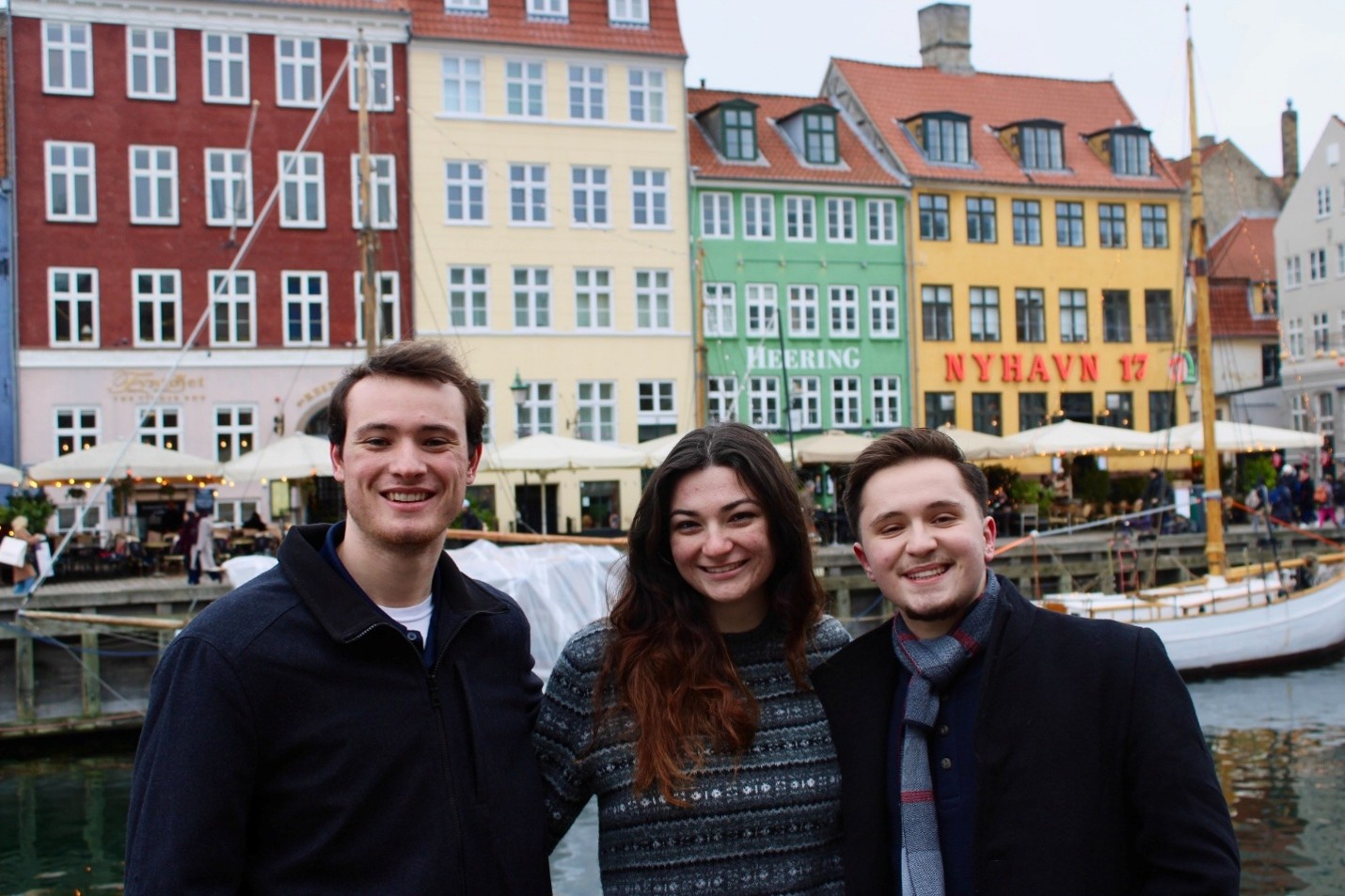
The Copenhagen Exchange Program at Massachusetts Maritime Academy is a specialized five-month study abroad opportunity primarily for junior Emergency Management cadets. Partnering with the University College Copenhagen (Københavns Professionshøjskole), the program allows selected students to earn 15 credits while completing international coursework and a co-op.
FAQs/ Timeline/ Checklist
Q. Who is eligible to apply, and when does the application process begin?
A. The program is for Juniors. Cadets with a 3.0 or higher are eligible to apply in the fall semester of their Junior Year. Dr. Valla will send out a reminder to rising juniors before classes end in the previous spring semester. The application process involves submitting a letter requesting consideration for the program to Dr. Valla.
Q. How do I apply?
A. Submit a short, less than one page, narrative describing why you would like to study in Denmark, and how you think it would benefit you personally and professionally. Submit your narrative to Dr. Valla on or before September 15. Applicants will be interviewed by Dr. Valla and Professor Lennon the following week. Selectees will be notified on or before September 30. The program can select up to 3 students.
Q. What happens if I’m selected?
A. A great deal happens which requires your CONSTANT attention and FREQUENT communication with Dr. Valla, Mr. Nobrega, Ms. Cerud-Ahern, Professor Nielsen (at the University College of Copenhagen, and other housing contacts at the University College of Copenhagen, (TBD). You will, at a minimum, email Dr. Valla, Professor Nielsen, and Ms. Cerud-Ahern every week with the administrative steps you have taken/or need to be taken. You will do this until the plane carrying you to Denmark takes off. If you don’t, you will be removed from the program.
*****The most important initial step after selection is to work with Mr. Nobrega and Ms. Cerrud-Ahern to schedule a trip to New York City to obtain a student VISA to study in Denmark.*****
Q. What is the VISA application process like?
A. Obtaining a VISA can take time, which is why it is an important first step. The VISA application process begins at the Cuffe Center where they will advise you on what documents are required to complete the application. This process normally begins by the end of September. Cadets make appointments with VFS Global
https://www.vfsglobal.com/en/individuals/index.html to visit the Danish Consulate in New York City. Cadets use the website nyidanmark.dk or “New In Denmark” with help from the Cuffe Center. The first step was to create an application for a Student/Long Term Residence Visa, and then receive our Case Order ID number and pay the application fee.
VFS Global is a third-party contractor that coordinates visa applications for the Consulate of Denmark. They have very specific rules for the application which we will review. The closest VFS Global Office is New York City with another in Washington D.C. Students will book their travel accordingly with guidance from the Cuffe Center.
Q. How do I get to New York?
A. Previous cohorts have driven to New Haven, Connecticut at around 5 in the morning. From there, they took the train to Grand Central Station for about $43 per person, roundtrip.
Q. How long does the process take at VFS Global?
A. It can take a while. Even with appointments, waiting times can be long. Unless you want to pay to store it, do not bring a laptop.
Q. How do I know my application is being processed?
A. Previous cohorts received an email the next morning confirming that the applications were being processed.
Q. What documents do I need for VFS Global appointment:
– Receipts for fee payments
– Passport
– Photocopies of passport
– Appointment confirmation letter
– Letter of Acceptance to KP
– Bank statement proving you can finance your stay (at least $1,000 USD per month of the trip.) Prepare to transfer money as soon as you have been selected so that your most recent bank statement reflects the amount needed for visa approval.
Q. Are there fees I should expect?
A. Yes. These typically involve VISA application and related fees. The exact dollar amounts may vary, but expect between $500-$700.
Q. Do I sign up for a CO-OP?
A. Yes. Dr. Valla will notify LT Vanasse that you have been selected for the Denmark Program. It is then up to you to schedule an appointment with her to ensure you have satisfied any requirements from Career Services. Cadets participate in a 14-15 week internship prior to the start of classes.
Q. When do I pay for the CO-OP?
A. You will be registered for Winter Co-op, so you will follow the guidelines for winter co-op registration and payment dates so you don’t incur any late fees. Because it is coded as a winter coop, the bill is due in early December. If the CO-OP were coded as a spring bill, the bill is due at the same time the regular spring bill is due (early February). In the unlikely event that it is coded as a summer coop, the bill is due by June 1st.
Q. Who arranges the CO-OP?
A. Professor Nielsen at KP will try to locate suitable CO-Ops. However, if there is a particular field or company you know of, you should feel free to reach out and ask for assistance from Dr. Valla and LT Vanasse.
Q: Are the CO-OPS paid? Can I work a part-time job while I’m in Denmark?
A. No.
Q. What communication should I expect from the University College of Copenhagen?
A. There are several vital items that take place very soon after your selection, including: the offer of housing, establishing your student KP email account, a signed learning agreement, and your student number. You must, immediately upon receipt of a request for information from anyone at KP, respond. You will copy Dr. Valla and Professor Nielsen on all email correspondence, and you will include the action requested, what you did to comply with the requested information, when, and if there are any other actions you need to take.
Q. What Mass Maritime courses are satisfied in the study abroad program?
A. The Denmark study abroad program satisfies 15 credits: 3 electives, International Relief, and Public Health. The program also requires completing a co-op which satisfies one of the two required CO-OPs for the Emergency Management major.
Q. How long is the course of study at KP?
A. Internship: 10 weeks (completed first); Elective course: 4 weeks; The Interprofessional course: approximately 6 weeks (dependent on when the exam is)
The theme of the courses can still change for spring 2027, but so far the plan is: Elective course will be Event Safety: The Interprofessional course will be Interprofessional Collaboration in Disaster Risk Management: Challenges and Opportunities.
Q. Do I study Danish while overseas?
A. Yes. *Additionally, before you go, you may want to start learning a few basic phrases. In preparation for my sabbatical next fall, I have been using Duolingo (it’s free); Babble, and YouTube videos titled Mic’s Languages.
Q. How much does it cost?
A. MMA charges tuition and fees but not housing. Expenses vary depending on scholarships, financial aid, etc.
You will be charged the standard tuition and fees that all students pay at MMA. Housing and food are not charged by MMA. When your financial aid is determined, MMA will take into consideration the fact that you will have housing and food charges that you will be charged in Copenhagen. If you have enough financial aid to cover the tuition and fee portion of your bill at MMA, any excess aid will be refunded to you in December to use toward your living expenses.
Q. How much does housing cost, and where do I live?
A. ****This has been subject to change.**** The 2025 cohort lived in new facilities. Previously, KP University College Copenhagen rents each semester several rooms at the dormitory Håndværker-skolehjemmet for incoming international students. Each room is approximately 10-12m2.
In each room there is a wardrobe, a desk and two single beds. Each room has its own bathroom. You have access to wireless internet in the room, which is included in the rent. You will receive a password to the internet when you arrive. Bispebjerg and Emdrup is part of Copenhagen and is not far from the center of Copenhagen. Håndværker-skolehjemmet is located in a nice area, with a lake, park, sports hall, a shopping center and a public swimming pool. All within 2 km from the dormitory.
All that said, Copenhagen is easy to navigate by foot, bicycle, metro, bus, and train.
The previous range for housing was $3,500-$5,000. This is subject to change, but a good benchmark.
Q. Are there other costs?
A. Yes, application for the University College of Copenhagen is $330. (Subject to change, but a good benchmark). Additional costs out of pocket are travel insurance, airfare, groceries (in Copenhagen), bike rentals, etc.
Q. Who at the Academy can help me navigate the process?
A. I am the primary point of contact for general questions, Dr. Edward Valla, (evalla@maritime.edu). Specific Questions regarding visas, housing, payment should be directed to those below.
1. LT Nancy Vanasse (nvanasse@maritime.edu) Assistance with locating CO-Ops and Career Service Requirements
2. Ms. Brienne Klaassen (bklaassen@maritime.edu) Anything involving payment amounts, dates, deadlines
3. Mr. Patrick Nobrega (pnobrega@maritime.edu) Visa/Travel, living abroad
4. Ms. Pamela Cerrud-Ahern (pcerrud@maritime.edu) Visa/Travel, living abroad
Fire Academy Program
Emergency Management cadets with an interest in pursuing careers as fire-fighters may apply for the firefighting program during the spring semester of their freshman year (read more)…
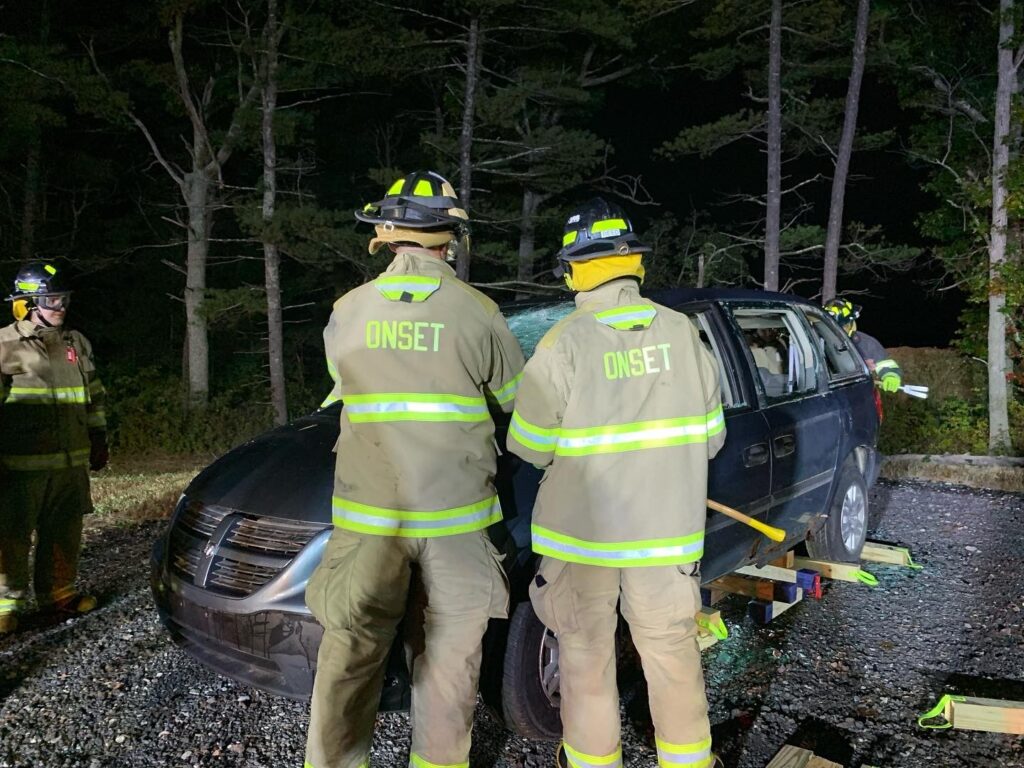
The program is conducted in partnership with the Onset Fire Department and provides the opportunity for those selected to be trained and certified as firefighters and gain real-world, practical experience responding to emergencies with the Onset Fire Department.
Under the guidance of Fire Chief Jeffrey R. Osswald, cadets will attend a recruit training program consisting of 240 hours of classroom and practical skills instruction over several months of their sophomore year. The program culminates with the cadets taking the National Board on Firefighting’s Professional Qualifications Firefighter I/II Certification examination. Cadets spend the remainder of their time at the Academy responding to a wide range of emergency incidents, including, structure fires, motor vehicle accidents, emergency medical incidents, hazardous materials incidents, water rescues, and brush fires, to name a few.
Cadets will train regularly and spend duty shifts at the station throughout their time in the program. Many graduates of the program, in combination with their B.S. in Emergency Management, have gone on to secure full-time employment in the fire service, law enforcement, the Armed Forces, and other rewarding occupations.
The application process begins in the freshman year. Dates are determined by the Onset F.D., and have been in the late fall, or late spring. Applicants are normally limited to freshmen cadets. Formal interviews are conducted with members of the Onset F.D., currently participating cadets, and Dr. Valla.
The Emergency Management Department’s liaison with the Onset Fire Department is Dr. Edward J. Valla. evalla@maritime.edu.
Emergency Medical Technician Course
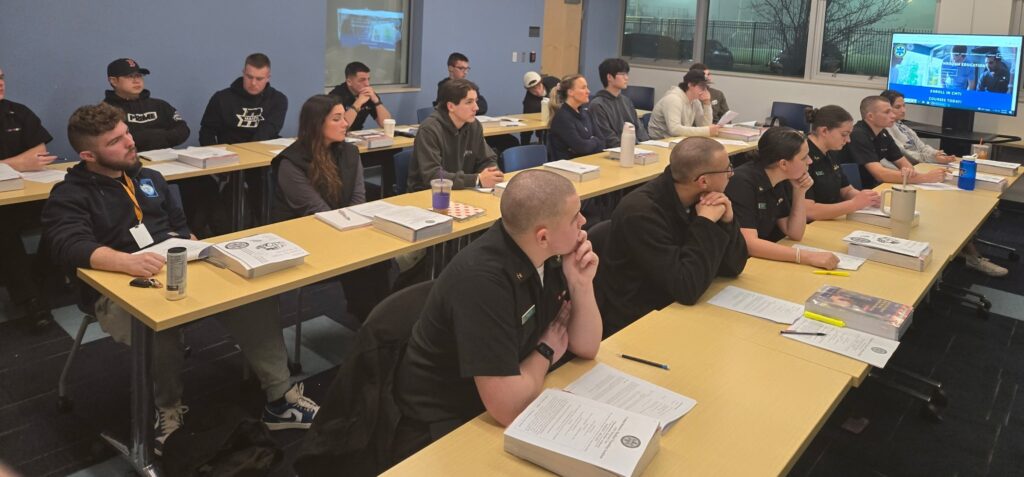
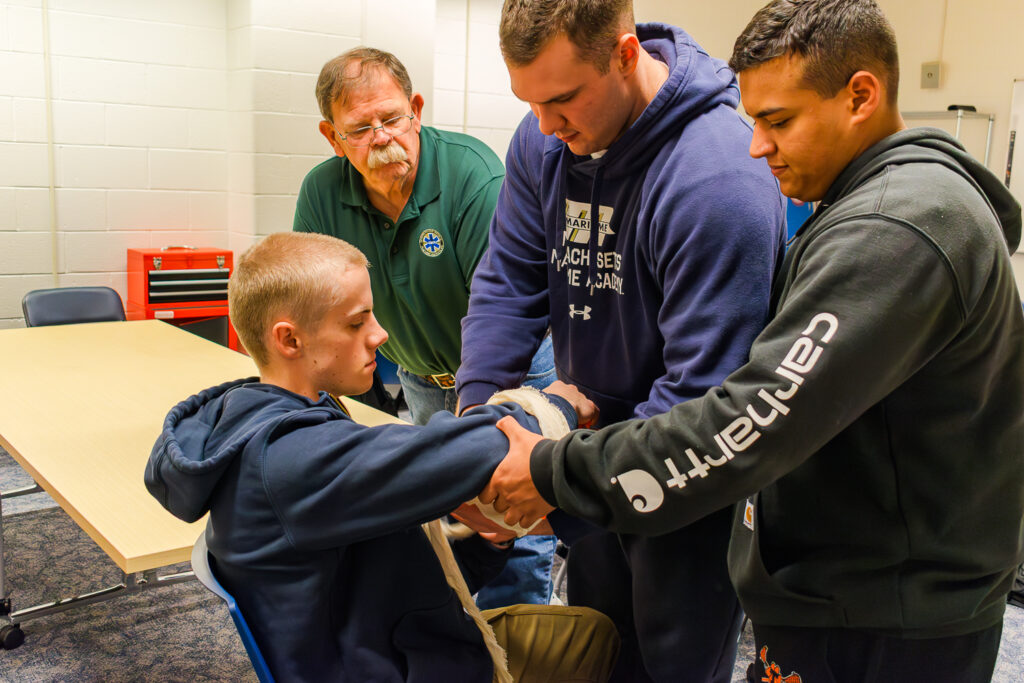
The Massachusetts Maritime Academy has partnered with the Comprehensive Medical Teaching Institute (CMTI) to offer the EMT-basic course on campus during the spring and fall semesters. (read more)…
CMTI has educated healthcare professionals and first responders since 2009. CMTI is an approved and accredited EMS training program through CoAEMSP and the Massachusetts Department of Public Health, Office of Emergency Medical Services.
The EMT course is taught in a hybrid model, with cadets participating in class one evening per week from 1800-2200, and requires significant online asynchronous homework and quizzes.
The course is open to all MMA cadets, and the in-person instruction takes place in Harrington 102 and 103.
Registration and payment for the course is through CMTI’s website: https://www.cmtiinc.com/
The EMT course is worth 4 academic credits. Students who complete training, pass the national exam, and receive their EMT certification may use their certification as a substitute for a free elective.
Students who earn the EMT certification and enroll in the on-campus paramedic program may use their certification for any one of the following required courses:
MS 3242 Hazardous Materials Management
EM 7210 Business Continuity
EM 4113 International Relief
SS 4132 Legal Issues in EM
EM 4224 Capstone
EM 4227 Disaster Recovery